Which Was a Major Feature of Baroque Art Answerscom
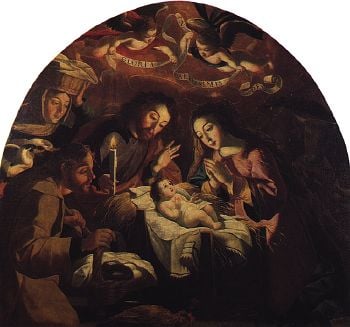
Nativity by Josefa de Óbidos, 1669, National Museum of Ancient Fine art, Lisbon
The Baroque manner began as somewhat of a continuation of the Renaissance. Later on, even so, scholars of the time began to meet the drastic differences between the two styles every bit the Renaissance fashion gave way to Bizarre art. Bizarre compages, sculpture, and painting of a dramatic nature were powerful tools in the hands of religious and secular absolutism, and flourished in the service of the Catholic Church and of Cosmic monarchies. The Baroque artists were specially focused on natural forms, spaces, colors, lights, and the relationship betwixt the observer and the literary or portrait discipline in order to produce a potent, if muted, emotional experience.
The Council of Trent (1545-1563), in which the Roman Cosmic Church answered many questions of internal reform raised by both Protestants and by those who had remained within the Catholic Church, addressed the representational arts by demanding that paintings and sculptures in church contexts should speak to the illiterate rather than to the well-informed.
Contents
- 1 Overview of Baroque Painting
- 1.i Characteristics of Baroque painting
- 2 Architecture
- 2.1 Characteristics
- 3 Sculpture
- 4 Cardinal Artists of Baroque Art and Their Influences
- 4.one The Carracci'south
- 4.2 Caravaggio
- 4.three Gentileschi
- iv.4 Bernini
- 4.five Major Works Identifying the Bizarre Style in Italy
- 4.half dozen Other Influential Italian Artists
- 5 Dutch Artists
- five.1 Caravaggesques
- 5.2 Hals
- 5.iii Rembrandt
- 5.iv Honthorst
- five.5 Other Influential Dutch artists
- 6 Flemish Artists
- 6.one Peter Paul Rubens
- 6.1.one Major works
- 6.2 Other Influential Flemish artists
- 6.one Peter Paul Rubens
- seven Spanish Artists
- 7.1 Diego Velázquez
- 7.two Major works
- vii.3 Other Influential Spanish artists
- eight French Baroque
- 8.1 Georges de La Tour
- viii.2 Louis Le Nain
- 8.iii Other Influential French artists
- 9 Notes
- 10 References
- xi External Links
- 12 Credits
Due to this Bizarre art tends to focus on Saints, the Virgin Mary, and other well known Bible stories. Religious painting, history painting, allegories, and portraits were still considered the most noble subjects, but landscapes, still life, and genre scenes rapidly gained notoriety.
Overview of Baroque Painting
Characteristics of Baroque painting
Baroque art is characterized by bully drama, rich colour, and intense light and nighttime shadows. Every bit opposed to Renaissance art, which usually showed the moment before an event took place, Baroque artists chose the most dramatic point, the moment when the activeness was occurring: Michelangelo, working in the High Renaissance, shows his David composed and withal before he battles Goliath; Bernini's bizarre David is defenseless in the act of hurling the stone at the giant. Baroque art was meant to evoke emotion and passion instead of the calm rationality that had been prized during the Renaissance.
Baroque painting stemmed from the styles of Loftier-Renaissance painters such as Michelangelo, Raphael, Titian, and Correggio. Walter Friedlaender refers to such "elements as involvement in verisimilitude and naturalism (often with a strong emblematic content), representations of extreme states of feeling, a desire to propose extensions into space, dynamic movement, an intense engagement with light (in its physical and spiritual connotations) and a sensitivity to the impact of Classical civilizations, as representing some of the salient features of Baroque art." Although the era of the seventeenth century is said to be quite ambivalent toward any one style, the Bizarre painters exhibited several characteristics in their painting that made information technology clear that the work was Baroque: 1) painterly brushstrokes, ii) recession of the plane, 3) open form, iv) unity, and 5) unclearness of subject.
Architecture
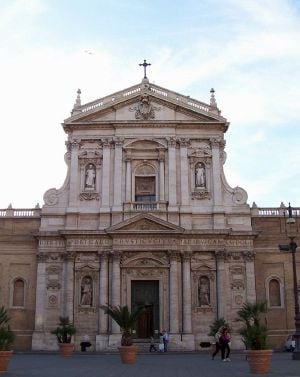
Santa Susanna: Carlo Maderno.
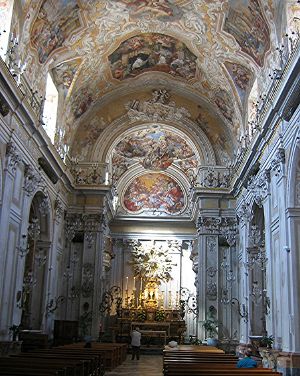
Sicilian Baroque: San Benedetto in Catania.
The Baroque architectural style came into effect in the construction of Il Gesù (Church of Jesus). The edifice was constructed by Giacomo da Vignola (designer of basis plan) and Giacomo Della Porta, who designed the façade. The basic scheme of the façade is prevalent throughout Catholic countries and was used as a model for over ii centuries. The Baroque played into the demand for an architecture that was on the one hand more than accessible to the emotions and, on the other hand, a visible argument of the wealth and ability of the Church. The new style manifested itself in detail in the context of new religious orders, like the Theatines and the Jesuits, which aimed to amend popular piety.[ane]
Characteristics
- long, narrow naves are replaced by broader, occasionally circular forms
- dramatic use of lite, either strong light-and-shade contrasts, chiaroscuro effects (east.thousand., church of Weltenburg Abbey), or uniform lighting by ways of several windows (e.thousand. church of Weingarten Abbey)
- opulent use of ornaments (puttos made of wood (often gilded), plaster or stucco, marble or faux finishing)
- large-scale ceiling frescoes
- the external facade is often characterized by a dramatic central project
- the interior is oftentimes no more than a shell for painting and sculpture (especially in the late bizarre)
- illusory effects similar trompe l'oeil and the blending of painting and compages
- in the Bavarian, Czech lands, Poland, and Ukrainian bizarre, pear domes are ubiquitous
- Marian and Holy Trinity columns are erected in Cosmic countries, often in thanksgiving for ending a plague
Sculpture
Bizarre sculptors experienced a sense of freedom to combine and create what their minds could call up of. Many artists felt free to combine different materials inside a single work and often used one material to simulate another. One of the keen masterpieces of bizarre sculpture, Giovanni Bernini's Saint Theresa from the Cornaro Chapel, for example, succumbs to an ecstatic vision on a dull-finished marble cloud in which bronze rays descend from a subconscious source of low-cal. Many works of Baroque sculpture are set within elaborate architectural settings, and they oft seem to be spilling out of their assigned niches or floating upward toward heaven.[ii]
"The distinctive features of baroque statues are a) the utilise of more than 1 cake of marble, thus assuasive a large array of gestures; b) the treatment of drapery, which does not autumn in an ordinary mode, only is moved by a sort of air current; c) the apply of variegated/colored marble or of different marbles; d) a torsion of a very often tall and slim body." [three]
Key Artists of Baroque Art and Their Influences
The Carracci's
Baroque monumental painting was brought into existence past the Carracci: brothers Annibale and Agostino Carracci, and cousin Ludovico Carracci. "The Carracci aimed at a synthesis of vigor and majesty of Michelangelo, the harmony and grace of Raphael, and the color of Titian, less through direct simulated of these Loftier Renaissance artists than through emulation of their method of idealizing nature." [two] In other words, they were attempting to revitalize seventeenth century art with Renaissance ethics of nature, and their ideas of color and unity. The Carracci were associated with the Bolognese Academy, with their cousin Ludovico being the founder of the schoolhouse. The premise of the Carracci'due south Bolognese Academy was that, "art tin can be taught—the basis of any academic philosophy of art—and that the materials of instruction must be the traditions, the antique, and the Renaissance, in addition to the studying and drawing from life." [1]
Caravaggio
A revolutionary, Caravaggio changed the course of European art. "The psychological realism, which plumbed the depths of human feeling in a manner comparable in some respects to the insights of his slightly older gimmicky, William Shakespeare, and its extraordinary sense of solid reality projected in actual space." [2] Caravaggio became renown for his use of chiaroscuro, his about constructive device to awaken the deep recesses of the soul. Chiaroscuro was the employ of contrasting lite and dark colors and shadows.
Gentileschi
Artemisia Gentileschi, pupil and daughter of Orazio Gentileschi, structured her painting around the tumultuous by of her youth. Later beingness raped by Orazio's educatee, Agostino Tassi, Artemesia'southward reputation was scarred. Every bit a result, much of the subject matter in her piece of work deals with feminist subjects being wronged by men, and the heroic revenge they accept on men. It is articulate that the female person in all of her works is a cocky-portrait.[2]
Bernini
Gian Lorenzo Bernini'southward touch on Baroque art, particularly in the latter stages of the way, is unquestionable. Bernini produced major works in architecture, sculpture, paintings, and was a dramatist and composer. In fact, he was the model sculptor for all those that followed him in the historical timeline. His style in all mediums exhibited an unmatched intensity and vibrance that seemed to exist bringing everything that he created to life.
Major Works Identifying the Bizarre Style in Italy
- Carraci's Ceiling paintings at Palazzo Farnese (Farnese Palace)
Annibale Carraci'southward ceiling paintings are clearly influenced by Michelangelo'due south Sistine Chapel. Typical of Baroque art, "information technology is essential for our understanding of the Bizarre that divine love, conceived every bit the principle at center of the universe, should be the motive power that draws together all the elements of the ceiling and resolves all conflicts in an unforeseeable act of redemption."[ii] The energy among all the figures is controlled however powerful and arable. It is extremely hard to distinguish reality from representation. In other words, the Baroque style is characterized by a more sensual, at times erotic display of affection, not just in painting, but in sculpture and architecture every bit well.
- Landscape with the Flying into Egypt
In his landscapes, Carracci principally strays away from the high indicate of view so that the figures in the scene are at the same middle level equally the viewer. A second, more discernible characteristic of his landscape paintings is the fact that they are not fantastic or imaginative; in fact, they are based on the actual environs of Rome. In this piece, it is the Tiber and the Alban Hills: "The mural in this painting, equally almost always in the seventeenth century, was derived from studies made outdoors merely was constructed in the studio." [2]
- Caravaggio's Calling of Saint Matthew
The use of shadows to contrast the calorie-free and dark is at its best in this piece. While the theme of Saint Matthew's calling is prevalent in fine art history, none other can rattle the soul as Caravaggio's slice does. Christ is illuminated in light as the edge of his fingertips reflects off the ray of light in the darkened room. The faces of the three boys are illuminated in surprise as they see the vision of Christ: "The background is a wall in a Roman tavern; a window, whose panes are the oiled newspaper customary before the universal use of glass, is the merely visible back-footing object." [2]
- Artemesia Gentileschi's Judith with the Head of Holofernes
The passion and free energy is bursting out of the surface of the piece, and the only light in the piece is from the candle (chiaroscuro), which gives us a direct view of the sinister shadow on Judith's face: "The victorious Hebrew heroine casts one last glance backward into the darkened tent as her maidservant is about to wrap the severed head." [2]
- Gian Lorenzo Bernini's David
When one compares Bernini's David to that of Michelangelo and Donatello, information technology becomes clear why the style is Baroque. Ane of the fundamental features of Baroque sculpture that is prevalent in this slice is Bernini'due south depiction of the scene in the precise moment at which David is twisting vigorously, as he is in motility to release the rock: "The left hand's tightening nearly the sling and stone produces sharp tensions in the muscles and veins of the arm, the toes of the correct human foot grip the rock for …" [2] Vibrance emanates from this work and is hands distinguished by the emotion of the figure and the contortions of the trunk.
Other Influential Italian Artists
- Carlo Maderno
- Francesco Borromini
- Bartolomeo Manfredi
- Carlo Saraceni
- Battistello Caracciolo
- Guido Reni
- Francesco Albani
- Domenichino
- Guercino
- Daniele Crespi
- Domenico Fetti
- Pietro Tacca
- Pietro da Cortona
- Alessandro Algardi
- Baciccio
- Andrea Pozzo
- Luca Giordano
- Carlo Maratti
- Francesco Furini
- Carlo Dolci
- Evaristo Baschenis
- Bernardo Strozzi
- Bernardo Cavallino
- Mattia Preti
Dutch Artists
Caravaggesques
Of the many artists that were bound to Caravaggio's charm were Hendrick Terbrugghen and Gerard van Honthorst. The two were known equally the principal Caravaggesques because "their religious paintings evidence understanding of Caravaggio'south new vision of ordinary humanity reached by divine beloved." [2] Honthorst's primarily focused on biblical scenes done in the dark, while Terbrugghen, like Caravaggio, paints with an aureola of uncertainty. The background is ready, seemingly, in the middle of nowhere. Terburgghen explored the Baroque psychological attribute of Caravaggio's art.[ii]
Hals
Frans Hals was arguably the almost brilliant of all portraitists. Every bit an upwardly and coming artist, he was interested in niggling but the human face and effigy. He possessed an unrivaled ability to capture "the moment of activity, feeling, perception, or expression and recording that moment with tempestuous but unerring strokes." [2] His utilize of light and nighttime is less intense than Caravaggio, but his style of portraiture is original. In The Laughing Cavalier the groundwork is definite and unimportant. All the attention is on the face of the portrait. "The dotty proclivities of the beau may exist indicated by the arrows, torches, and bees of Cupid and the winged staff and chapeau of Mercury embroidered in cherry, silverish, and gold on the dark brownish of his slashed sleeve. With his glowing complexion, dangerous mustaches, snowy ruff, and dashing lid, the subject is the very symbol of Bizarre gallantry; the climax of the painting is the taunting smile on which every compositional strength converges." [2]
Rembrandt
Rembrandt van Rijn dealt with secular subjects too as biblical themes; however, it is the spirituality of his art that sets him apart from his Dutch contemporaries, and for that matter, all artists. He was one of the few artists that signed his works with his own name. While he lived in an era where artists were banned from showing their paintings in churches, Rembrandt addressed the private by the use of "radiant low-cal and vibrant shadow, receptive to the deepest resonances of human feeling." [one] In Supper at Emmaus, Rembrandt resurrected Caravaggio's use of lite and night with an intensity that has put him in the history books. In this piece, Rembrandt depicts the revelation of Christ as savior to his disciples, an almost automatic subject in the Bizarre age. The point of revelation to his disciples is represented with a sudden outburst of light from darkness, hinting at the release into heaven from this darkly material world. Suddenly, the expanse where Christ is standing turns into an alcove and the tabular array becomes an chantry, both of which are illuminated with rays from Christ's caput. The daze of the scene is farther elevated to new heights by Rembrandt in that everyone is still, there is no motion in the slice.
Honthorst
Gerrit van Honthorst distinguished himself grade other artists in that he specialized in painting in the dark. In Adoration of the Shepherds, Caravaggio's influence is evident in the mysterious background and the rough edges in the midst of radiating light.
Other Influential Dutch artists
- Pieter Lastman
- January Pynas
- Dirck van Baburen
- Jan Lievens
- Gerard Dou
- Jacob Backer
- Govaert Flinck
- Ferdinand Bol
- Carel Fabritius
- Samuel van Hoogstraten
- Gerbrand van den Eeckhout
- Philips Koninck
- Nicolaes Maes
- Willem Drost
- Aert de Gelder
- Willem Buytewech
- Jan Molenaer
- Adriaen van Ostade
- Isaac van Ostade
- Pieter de Hooch
- Gerard ter Borch
- Gabriel Metsu
- Frans van Mieris the Elder
- Jan Steen
- Gillis van Coninxloo
- Roelant Savery
- Hendrick Avercamp
- Esias van de Velde
- Hercules Seghers
- Pieter de Molyn
- Jan van Goyen
- Salomon van Ruisdael
- Jacob van Ruisdael
- Aert van der Neer
- Frans Post
- Aelbert Cuyp
- Meindert Hobbema
- Paulus Potter
- Philips Wouwerman
- Willem van de Velde the Younger
- Cornelis Vroom
- Simon de Vlieger
- January van de Cappelle
- Michael Sweerts
- Jan Both
- Nicolaes Berchem
- Jan Weenix
- Karel Dujardin
- Thomas de Keyser
- Pieter Saeredam
- Emanuel de Witte
- Gerrit Berckheyde
- Jan van der Heyden
- Ambrosius Bosschaert the Elder
- Pieter Claesz
- Willem Heda
- Jan Davidsz de Heem
- Willem Kalf
- Rachel Ruysch
- Abraham van Beyeren
Flemish Artists
Peter Paul Rubens
Past completing the fusion of the realistic tradition of Flemish painting with the imaginative liberty and classical themes of Italian Renaissance painting, Peter Paul Rubens fundamentally revitalized and redirected northern European painting.[ii] Afterwards the death of his father, Rubens traveled to Venice, where he fell under the spell of the radiant color and royal forms of Titian. During Rubens'southward eight years (1600-1608) as court painter to the duke of Mantua, he assimilated the lessons of the other Italian Renaissance masters and made (1603) a journey to Spain that had a profound bear upon on the development of Spanish baroque art. He also spent a considerable amount of time in Rome, where he painted altarpieces for the churches of Santa Croce di Gerusalemme and the Chiesa Nuova, his commencement widely best-selling masterpieces. His reputation established, Rubens returned (1608) to Antwerp following the death of his mother and quickly became the dominant artistic effigy in the Spanish Netherlands.
Major works
- Raising of the Cross
- Rape of the Daughters of Leucippus
- Autumn of the Damned
- Garden of Love
All of Rubens's works exhibit the brawny exuberance that somewhat contradict his devout biblical perspective. In most of his works, the figures are nude and there is an act of animalism occurring. Corybantic energy and movement best narrate his work, with a swift round motion that resembles the S-curve of classical sculpture. Glowing color and light that flickers across limbs and draperies resulted in spiraling compositions such as The Descent from the Cross with a characteristically baroque sense of movement and power.
Other Influential Flemish artists
- Adriaen Brouwer
- Joost de Momper the Younger
- Paul Bril
- Jakob Jordaens
Spanish Artists
Diego Velázquez
Velázquez had a colossal impact on European art. Much of his work focused on landscapes, mythology, and religious painting; notwithstanding, he spent the majority of his life in portraiture. Existence a painter in the Madrid court, many of his portraits are of court nobles. Velasquez was called the "noblest and nearly commanding man among the artists of his country."[2] He was a master realist, and no painter has surpassed him in the ability to seize essential features and fix them on canvas with a few broad, sure strokes. "His men and women seem to breathe," it has been said; "his horses are full of action and his dogs of life." [2]
Because of Velasquez' great skill in merging colour, lite, space, rhythm of line, and mass in such a way that all have equal value, he was known as "the painter'south painter." [2] Always since he taught Bartolomé Murillo, Velasquez has directly or indirectly led painters to make original contributions to the evolution of fine art. Others who have been noticeably influenced past him are Francisco de Goya, Camille Corot, Gustave Courbet, Edouard Manet, and James McNeill Whistler.
Major works
- The Surrender of Breda(an equestrian portrait of Philip Iv)
- The Spinners
- The Maids of Award
- Pope Innocent X
- Christ at Emmaus
Other Influential Spanish artists
- Fra Juan Sánchez Cotán
- Francisco Ribalta
- Bartolomé Esteban Murillo
- Alonso Cano
French Baroque
Georges de La Bout
The tide of psychological realism that Caravaggio gear up in motion eventually reached Georges de La Tour, and he embraced it. His paintings resemble Caravaggio in his hard and polished surfaces and in his stiff low-cal-and nighttime contrasts, just the content is drastically dissimilar.[ii] La Tour's skillfully renders paintings of Christ and the Virgin Mary, still never really tells the reader that they are who they are. While near paintings depicting the birth of Christ have rays of low-cal emanating from the kid, La Tour has the midwife carrying a candle. In other words, behind his painting, in that location is a surreal sense of humanity, and the beginning of a new life that captures the awe of its viewers.
Louis Le Nain
Louis Le Nain painted ordinary people performing ordinary activities in almost majestic manner. The figures in the painting seem to be revered: "they stand or sit calmly among the poultry and pigs of a farmyard, in groups composed with such dignity that the rough cart is endowed with awe-inspiring grandeur." [2] In The Cart the "richly painted colors—muted grays, tans, and browns in the wearable with an occasional touch on of ruddy, soft grays and blues in the pearly sky, grays and greens in the landscape—make this piffling masterpiece a worthy antecedent of Chardin in the eighteenth century and Corot in the nineteenth." [2]
Other Influential French artists
- Claude Lorrain
- Nicolas Poussin
- Valentin de Boulogne
- Simon Vouet
- Jacques Blanchard
- Laurent de La Hyre
- Lubin Baugin
- Philippe de Champaigne
- Nicolas Tournier
- Gaspard Dughet
- Eustache Le Sueur
- Sébastien Bourdon
- Charles Le Brun
- Antoine Coysevox
- Pierre Legros the Younger
- Pierre Mignard
- François Girardon
- Jean Jouvenet
- Jean-François de Troy
- André Le Nôtre
Notes
- ↑ 1.0 1.1 one.2 Helen Gardner, Art Through the Ages, 6th Edition (Harcourt Brace Jovanovich, Inc. 1975, ISBN 0155037536).
- ↑ 2.00 2.01 2.02 2.03 2.04 2.05 two.06 two.07 2.08 ii.09 two.x 2.eleven two.12 2.thirteen 2.fourteen 2.15 2.16 2.17 ii.18 2.19 Frederick Hartt, Art: A History of Painting, Sculpture, and Architecture, Third Edition (Englewood Cliffs, NJ: Prentice-Hall; New York: H.Northward. Abrams, 1989, ISBN 9780130486387).
- ↑ Baroque Sculpture in Rome Retrieved March 10, 2021.
References
ISBN links support NWE through referral fees
- Gardner, Helen. Art Through the Ages, Sixth Edition, Harcourt Brace Jovanovich, Inc. 1975. ISBN 0155037536
- Hartt, Frederick, Fine art: A History of Painting, Sculpture, Architecture. New York: Harry N. Abrams, Inc., 1989. ISBN 0810918846
- Held, Julius Samuel, and Daniel Posner, 17th and 18th Century Art; Baroque Painting, Sculpture, Architecture. New York: H.N. Abrams, 1971. ISBN 978-0810900325
- Wittkower, Rudolf. Art and Architecture in Italy 1600-1750. Vol. 1: Early Baroque (Yale Academy Press Pelican History of Art) Yale University Press, 1999. ISBN 978-0300079395
External Links
All links retrieved December 31, 2021.
- Life of Velazquez
- Bizarre Art
- Bizarre Artists and their works
- Baroque Sculpture
- Bizarre Architecture
Credits
New World Encyclopedia writers and editors rewrote and completed the Wikipedia article in accordance with New Globe Encyclopedia standards. This article abides past terms of the Artistic Eatables CC-past-sa three.0 License (CC-by-sa), which may be used and disseminated with proper attribution. Credit is due under the terms of this license that tin reference both the New World Encyclopedia contributors and the selfless volunteer contributors of the Wikimedia Foundation. To cite this commodity click hither for a listing of acceptable citing formats.The history of before contributions by wikipedians is accessible to researchers here:
- Baroque_art history
The history of this article since it was imported to New World Encyclopedia:
- History of "Baroque art"
Note: Some restrictions may apply to use of individual images which are separately licensed.
0 Response to "Which Was a Major Feature of Baroque Art Answerscom"
ارسال یک نظر